Lyndon Drake

I work across artificial intelligence and theology.

AI · biblical studies · Indigenous theology · finance & capital · governance · consulting

§ 01

Introduction

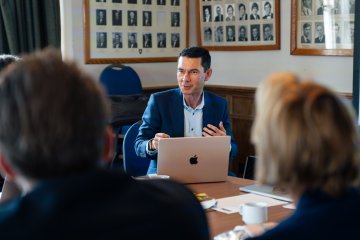
I work across artificial intelligence and Christian theology, with a PhD in AI (York, 2005), a DPhil in Theology (Oxford, 2023), and peer-reviewed publications in both fields. I am a Research Fellow in AI at the University of Oxford, and a Senior Research Fellow and Chaplain at St Edmund Hall. My current research examines how increasingly capable AI systems shape the formation and decision-making of the human person. I lead an international collaboration on a shared ethos to orient AI and its development to the good of the human person. My other current research activities include experimental work on LLMs and other AI systems, contributions to a large-scale financial machine learning project, research on AI’s effects on cognition — both support and degradation — and a workshop series I am co-organising with the Oxford Human-Centred AI Lab and the Centre for Ethics in AI.

My developing research programme addresses language, hermeneutics, and human formation in relation to AI. It draws together computational analysis of ancient and theological texts — with advanced work on literary dependence in ancient Greek and a planned project on the Dead Sea Scrolls — alongside theological reflection on AI as a mediating technology. I continue to work on Indigenous biblical studies, with a book proposal currently under review, and I am preparing a research grant proposal on algorithmic decolonisation, linguistic inclusion, and theological pedagogy. I have an active interest in the ethics of capital markets, building on my experience as a market-maker at Barclays Capital and my scholarly work on economics and writing in the Bible.

As an Archdeacon in the Māori Anglican Church, I recruited and developed a team of over twenty staff and clergy from a standing start, while overseeing some sixty licensed ministers in a high-deprivation setting. In finance, I worked as a market-maker at Barclays Capital with regular engagement with the UK Debt Management Office, central banks, pension funds, and hedge funds, and contributed to crisis management during the Lehman collapse. I have served on boards managing large-scale budgets and programmes of national significance in New Zealand, and have built research and funding partnerships across academic, charitable, and government sectors.

I have raised millions of dollars in grant funding for research and for charitable organisations, supported innovation in social housing, and built a church revitalisation model now replicated nationally. My published work addresses the ethics of capital markets and AI, and I remain committed to research whose technical rigour is matched by serious attention to its human and ethical stakes.

My research practice draws on extensive experience in leadership, strategy, governance, and finance across academic, charitable, and commercial sectors. I continue to undertake selected consulting work at the intersection of AI, strategy, and ethics.

§ 02

Synopsis

Qualifications

BSc (Hons), BCommerce (Auckland, 1999); PhD (AI, York, 2006); BA (Hons) (Theology, Oxon, 2012; MA taken 2017); MSt (Theology, Oxon, 2017); DPhil (Theology, Oxon, 2023).

Publications

Research outputs in theology and AI include one book (Capital Markets for the Common Good), several book chapters, peer-reviewed and popular articles, invited talks, and conference papers.

Academic

Range of academic prizes and service, research grants, and teaching experience in both Aotearoa/New Zealand and Oxford.

Work

DatePlaceRole
2024–OxfordResearch Fellow in AI, University of Oxford
2012–2024AucklandSenior church leader (plus governance & consulting)
2000–2011LondonInterest-rate trader, Barclays Capital (Vice President)

Key governance roles

Auckland City Mission (homelessness and food insecurity charity) — Trustee and Audit & Risk Committee member: successful development of NZ$120m award-winning new building (Homeground) in central Auckland for service delivery; annual revenue peak of NZ$61m.

Te Whare Ruruhau o Meri (family harm and sexual violence charity) — Chairperson: innovative multi-agency approach, annual revenue increased from NZ$1.8m to NZ$3.7m.

§ 04

Qualifications

  • 2017–2023

    DPhil (Theology), University of Oxford

    MORE

    Studying part-time and by distance with regular visits to Oxford, I completed a doctorate in Hebrew Bible/Old Testament. My thesis was submitted in September 2022, examined in December 2022, and passed with minor corrections (note that completing a DPhil in five years part-time is rapid). I graduated in May 2023. My thesis is in review for publication as an academic monograph.

    The thesis is a hermeneutical and ethical project motivated by Indigenous land rights and issues around the ethics of capital, examining Jeremiah 32 and related texts, and working in multiple ancient languages (primarily Hebrew, and also Aramaic, Syriac, Akkadian, Greek, Ugaritic, among others). My supervisor was Hindy Najman, the Oriel & Laing Professor of the Interpretation of Holy Scripture at Oriel College. My examination was by Prof. Konrad Schmid and Dr. Philip Lassater.

    Two novel contributions in the thesis are reading Jer 32 as a microcosm of the development of book of Jeremiah, and reading the material details of the chapter's economic descriptions as contributing to the rhetorical effect of the chapter.

  • 2016–2017

    MSt (Theology), University of Oxford

    MORE

    I worked on research which fed into my doctorate, focusing on three areas: economic laws in the Pentateuch, a philological point in Solomon's prayer of dedication for the temple, and the relationship between the crisis in Nehemiah 5 and the Pentateuchal laws. I continued to develop my biblical Hebrew and Greek, and studied three additional ancient languages (Akkadian, Aramaic, & Syriac) and two additional modern languages (German and modern Hebrew). I also took a number of Anglican studies classes at Ripon College Cuddesdon. My college was Christ Church, where I also served my title post in the cathedral.

  • 2010–2012; MA taken 2017

    BA/MA (Hons, Theology), University of Oxford

    MORE

    I was awarded first class honours (with first class honours in every subject), the Denyer & Johnson Prize for the best theology BA in 2012, and the Ellerton Theological Essay Prize for my dissertation. I served as Undergraduate Joint Consultative Committee member and Faculty Board student representative. I was a student at Wycliffe Hall, one of the Anglican halls at Oxford, and undertook ministry formation there.

    See also: Did Jesus Oppose the prosbul in the Forgiveness Petition of the Lord's Prayer?, Novum Testamentum 56 (2014), 233–244.

  • 2004

    Financial Regulation 1, Securities & Investment Institute (London)

    MORE

    This was a professional qualification, and was a regulatory requirement for being given a trading mandate by Barclays Capital as part of my work in financial markets.

  • 2000–2005; awarded 2006

    PhD (Computer Science), University of York

    MORE

    My thesis title was, "Combining Inference and Backtracking Search for the Propositional Satisfiability Problem," and my research output included seven refereed publications, and invited presentations at Instituto Superior Técnico (Lisbon), the University of Auckland, and the University of Wales (Swansea). I served as the research student representative on the departmental Board of Studies.

    Full-time study: 2001–2003; Thesis submission: Nov 2005; Award: Jul 2006.

  • 1999

    BSc (Hons, Computer Science), BCommerce, University of Auckland

    MORE

    My Bachelor of Science was awarded with first class honours and a Senior Prize (1998), and the Bachelor of Commerce was studied conjointly.

  • until 1994

    School, Carey College, Auckland

    MORE

    Two school Premier Awards for "Leadership, Academic Excellence and Representing the School" (1992, 1993). Top mark in New Zealand for the CSSEE Computer Science exam (1993), Distinction in the Australian Schools English Exam (1994), and two National Science Fair Merit Awards (1992, 1994).

§ 05

Publications

Books

2017
Capital Markets for the Common Good: A Christian Perspective. Oxford: The Oxford Centre for Enterprise, Markets, and Ethics.

Book chapters

2025
‘Karakia and inoi’. in It Works: Stories of Transformative Spiritual Practices, ed. Philip Halstead and Angelika Halstead, Auckland: Archer, pp. 187-197.
forthcoming
‘Theological facets of He Poi, an Indigenous chant’. in Reclaiming our tribal voice, ed. Anne Pattel-Gray, Melbourne: ATF.
forthcoming
‘Tūmanako me whakahounga: Forms of hope and renewal in the context of contemporary Aotearoa’. in Hope: Growing flourishing church communities that transform and heal people, ed. Greg Liston and Sarah Penwarden, Eugene, OR: Wipf & Stock.
2018
‘Episcopal fragmentation in Te Pouhere’. in Te Awa Rerenga Maha: Braided River, ed. Don Moffat, Auckland: Anglican Church in Aotearoa New Zealand and Polynesia.

Peer-reviewed articles

2023
Lyndon Drake. Translating Hebrew YHWH into the Māori language. Anglican Journal of Theology in Aotearoa and Oceania 2.1.
ABSTRACT

This article examines the challenges and approaches to translating the Hebrew divine name YHWH into te reo Māori, considering theological, linguistic, and cultural factors.

2014
Lyndon Drake. Did Jesus oppose the prosbul in the forgiveness petition of the Lord's Prayer? Novum Testamentum 56, pp. 233–44.
ABSTRACT

The article proposes that Jesus opposed the prosbul, a legal device attributed to Hillel that allowed debts to be collected after the sabbatical year. This reading illuminates the forgiveness petition of the Lord's Prayer in its socio-economic context.

2003
Lyndon Drake. The Interaction Between Inference and Branching Heuristics. Proceedings of the Sixth International Conference on the Theory and Applications of Satisfiability Testing (SAT 03).
2002
Lyndon Drake, Alan M. Frisch, Ines Lynce, Joao Marques-Silva, Toby Walsh. Comparing SAT preprocessing techniques. Proceedings of the 9th Workshop on Automated Reasoning.
2002
Lyndon Drake. Automatic generation of implied clauses for SAT. Proceedings of the Eighth International Conference on Principles and Practice of Constraint Programming (CP 2002), Doctoral Programme.
2002
Lyndon Drake, Alan M. Frisch, Ian Gent, Toby Walsh. Automatically reformulating SAT-encoded CSPs. Proceedings of the International Workshop on Reformulating Constraint Satisfaction Problems.
2002
Lyndon Drake, Alan M. Frisch, Toby Walsh. Combining inference and search for the propositional satisfiability problem. Proceedings of the Eighteenth National Conference on Artificial Intelligence (AAAI 02), Doctoral Consortium.
2002
Lyndon Drake, Alan M. Frisch, Toby Walsh. Adding resolution to the DPLL procedure for Boolean satisfiability. Proceedings of the Fifth International Symposium on the Theory and Applications of Satisfiability Testing (SAT 2002).
2001
Lyndon Drake, Alan M. Frisch, Toby Walsh. Automatic Generation of Implied Clauses for SAT. In Toby Walsh (Ed.), Proceedings of the 7th International Conference on Principles and Practice of Constraint Programming, LNCS 2239. Springer-Verlag.
2001
Simon Colton, Lyndon Drake, Alan M. Frisch, Ian Miguel, Toby Walsh. Automatic Generation of Implied Constraints: Initial Progress. In Proceedings of the 8th Workshop on Automated Reasoning, 2001, 17-18.

Conference papers

2024
With Sophia Johnson. The Subjugation of the Gibeonites: Israelite Identity and Persian Imperialism in Joshua 9. Deuteronomistic History, SBL: San Diego.
2024
Restraint and inequality. Early Christianity and the Ancient Economy, SBL: San Diego.
2024
Economic practices and identity construction. EABS: Sofia.
2023
The Māori and ancient Near Eastern pantheons in the context of Genesis 1 in te reo Māori. ANZABS: Tāmaki Makaurau/Auckland.
2023
The rhetorical effect of materiality in a text: Money, exchange, and writing in the field purchase of Jeremiah 32. EABS: Siracusa.
2023
Tropes in postcolonial uses of the Bible for indigenous identity formation. EABS: Siracusa.
2022
Jeremiah 32 as a microcosm of the Book of Jeremiah: Economic writing and prophetic writing. IOSOT Congress: Zurich.
2019
Capital in documents from the Judaean Desert: Ownership and time preference. Oxford Dead Sea Scrolls Colloquium (70 years of the Dead Sea Scrolls): Oxford.
2019
Nga pou whakairo o Te Karaiti Te Pou Herenga Waka. Te Tumu Whakapono: Victoria University of Wellington.
2018
Biblical economic texts in the light of Modern Monetary Theory. ASOR: Denver, CO.
2017
Economic justice: Towards a biblical theology of capital. Oxford-Hebrew University Graduate Conference: Oxford.

Review articles

2018
Review of Anderson, Gary A., Christian Doctrine and the Old Testament: Theology in the Service of Biblical Exegesis. Journal for the Study of the Old Testament 42.5, p. 170.
2014
Review of Kaminski, Was Noah Good? Finding Favour in the Flood Narrative. Pacific Journal of Baptist Research.
2014
Review of Walton and Sandy, The Lost World of Scripture: Ancient Literary Culture and Biblical Authority. Pacific Journal of Baptist Research.

Research reports

2025
AI for vulnerable older adults in Aotearoa. Selwyn Foundation.
2025
Whenua me te Whakapono: Land and Faith in Aotearoa. Home Foundation.

Preprints

In progress

in preparation
Katherine Guerrerio, Elena Capilla, Lyndon Drake, Sara Lumbreras. Designing Clinician-Centered Interpretability in Medical Image Diagnosis AI: A Case Study on Alzheimer’s Disease.
in preparation
Samuel N. Cohen, Lyndon Drake, Zihan Guo, Christoph Reisinger. Liquidity Provision and Rebate Design in Option Markets.
2020
Why we need the Church. Common Ground (Auckland: Venn Foundation).

Invited talks

2026
Wiping the Slate Clean: A History of Debt, Default and the Art of Forgiveness. Panel, Weekend of Mistakes, Hay-on-Wye.
2026
AI, Theology, & Human Formation: How our tools should shape us. Public lecture, Lanier Theological Library, Houston.
2026
Toward a Theology of Technology. Lanier Theological Library, Houston.
2025
Will AI Make Us Happier? AI panel debate, British Library.
2025
LLMs and Theology. LLMs\@Oxford conference.
2025
AI and Research Insights for Iwi Māori and Kaumātua/Kuia. Northern Iwi Leaders Forum, Waitangi, New Zealand.
2025
Whenua me te Whakapono: Land and Faith in Aotearoa. Home Foundation, Christchurch, New Zealand.
2025
Te Rauranga — Risks and Opportunities: Te Ao Māori, AI, and Data Sovereignty. Ngāti Ranana, London.
2025
Artificial Intelligence: Wisdom with Changing Technology. St Ebbe's Church, Oxford.
2025
Scholarly vocation, the Hebrew Bible, and AI. Logos Institute, Oxford.
2025
Developing a Theologically Informed Commitment for AI Practitioners. Keynote, AI and the Church Conference, Truett Seminary & Baylor University, Waco, Texas.
2025
Machine Learning and the Social Investment Agency. Social Investment Agency, Wellington, New Zealand.
2025
Machine Learning for Health in Vulnerable Older People. Ministry of Health, Wellington, New Zealand.
2025
Plausible Hope for Renewal in Aotearoa. Keynote, Laidlaw Hope Conference, Auckland.
2025
The Long Game — Case Study. Peregrine, Oxford.
2025
Vocation & Scholarship. Scholarship and Christianity in Oxford (SCIO).
2024
Distinguishing imperial domination from colonisation in the Hebrew Bible. Theologische Fakultät, University of Zurich.
2024
Ancient Near Eastern Mythologies and Pūrākau Māori. Te Wānanga Ihorangi, Auckland.
2024
Home Foundation Whenua Project Launch. Home Foundation, Christchurch, New Zealand.
2024
Introduction to postcolonial biblical studies. Evangelisch-Theologische Fakultät, University of Ruhr Bochum.
2024
Theological facets of He Poi, an indigenous chant. Raising Our Tribal Voice conference, University of Divinity, Melbourne.
2022
Eco-churches and mana whenua. Arocha New Zealand.
2022
NZCIS Winter Lecture: Acquiring and using knowledge: divine revelation, matauranga Māori, and science. New Zealand Christians in Science.
2022
Artificial intelligence and ethics. University of York.
2017
Launch event for Capital Markets for the Common Good. London Stock Exchange.
2017
Capital markets, quants, & ethics. Oxford Mathematical and Computational Finance seminar.
2017
Economics and artificial intelligence: threat or promise? State of Europe Forum, Malta (Christian event by Sallux.eu and the Schuman Foundation).
2017
Launch event for Evangelical Review of Theology Special Edition on Business and Theology. Nürnberg.
2003
Inference and search for the propositional satisfiability problem. Swansea University.
2003
Using inference to improve search on SAT problems. University of Auckland.
2002
Research overview. INESC (Lisbon).

Media

2026
En algunos círculos es controvertido distinguir a humanos de máquinas. Alfa and Omega newspaper article.
2012-2024
A range of New Zealand media appearances on Māori and religious issues.

§ 06

Academic

Awards and funding

  • Research grants from the Selwyn Foundation (an Anglican charity in Auckland, New Zealand) for scoping and development of approaches to the use of Artificial Intelligence in novel approaches to interventions for the benefit of vulnerable elderly people, particularly among Māori (2024–2025).
  • Research grant from the Home Foundation (an charity alleviating homelessness in Christchurch, New Zealand) towards a research report on Māori and Christian views on whenua (land) for the purposes of housing development (2024).
  • NZ$100,000 from the St John’s College Trust Board (an Anglican education charity in Auckland, New Zealand) towards the establishment of the Kingi Ihaka Research Centre (an independent Indigenous research institution) in Auckland, New Zealand (2021).
  • St John’s College Trust Board full scholarship for DPhil study (2017–2022).
  • Ellerton Essay prize for my essay, ‘Did Jesus oppose the prosbul in the forgiveness petition of the Lord’s Prayer,’ for the Faculty of Theology and Religion at the University of Oxford (2012).
  • Denyer & Johnson prize for the top BA Final Honours School result in Theology and Religion at the University of Oxford (2012).

Research experience

  • Operational lead on the John Templeton Foundation funded project, The Oxford Collaboration for Theology and Artificial Intelligence in the Ian Ramsey Centre for Science and Religion at the University of Oxford, led by Profs Mark Harris and Joshua Hordern. This project has built a global network of AI practitioners (scientists and engineers) and theologians, with a focus on the majority world.
  • Named contributor to the R Project for Statistical Computing, a free software environment for statistical computing and graphics.

Teaching

  • Tutorial teaching in Hebrew Bible/Old Testament and examining of dissertations at the University of Oxford, 2025–current.
  • ‘Whakapapa,’ taught course on Māori theology delivered by lectures at level 6 (final year undergraduate), Laidlaw College (Auckland, New Zealand), Laidlaw Māori theology paper (substantial redesign of course, delivery, and assessment), 2020.
  • ‘Tikanga Rangahau,’ research supervision of an undergraduate thesis at level 6 (final year undergraduate), Laidlaw College (Auckland, New Zealand), 2020.
  • ‘Theology at work,’ taught course on the theology of work delivered by lectures at levels 6 (final year undergraduate) and 7 (Master’s degree), Carey Baptist College (Auckland, New Zealand) (design of a new course, New Zealand Qualification Authority approval, delivery, and assessment), 2015.
  • Established the Carey Baptist College Centre for Lifelong Learning, a continuing education programme for Baptist ministers which provides certification for Baptist Church ministers in Aotearoa/New Zealand, and led its first year including all course design, administrative oversight, and assessment, at Carey Baptist College (Auckland, New Zealand), 2015. Carey Baptist College Centre for Lifelong Learning

Academic service

  • Assistant to the Hebrew Bible/Old Testament Seminar at the University of Oxford (2024–current)
  • Fixed-term Research representative on the Faculty Board and Faculty Research Committee for Theology and Religion at the University of Oxford (2025–current)
  • Reviewer for the Religions journal (2024)
  • Co-founder of the Kingi Ihaka Research Centre (an independent Indigenous research institution) in Auckland, New Zealand (2021)
  • Chairperson of Te Kaunihera (the board of governors) of St John’s Theological College, Auckland, New Zealand (2020–2022)
  • Member of the National Governing Council of Laidlaw College, New Zealand (2019–2020)
  • Member of Te Tauihu, the governance body for Orongonui, the in-house theological training programme for Te Pihopatanga o Te Tai Tokerau, New Zealand (2017–2019)
  • Guest editor of a special edition of the Evangelical Review of Theology on Business and Theology, January 2017. (Articles by Chris Wright, Kar Yong Lim, Myk Habets & Peter McGhee, Emiola Nihinlola, John Jefferson Davis, and Miroslav Volf. I contributed a number of review articles.) Business and Theology, January 2017.
  • Undergraduate representative on the Faculty Board for Theology and Religion at the University of Oxford (2010–2011)

Skills

  • Computer programming (R, Python, SQL, C++, Java, JavaScript, HTML, CSS, Rust)
  • Scholarly languages (Classical Hebrew, biblical Greek, Akkadian, Aramaic & Syriac — working proficiency)
  • Modern languages (German — reading, modern Hebrew — reading, Māori — basic proficiency)
  • Data analysis and artificial intelligence (large language models, fine-tuning and evaluation, computational text analysis, machine learning, inference, search)

Professional development

  • Dev Academy Aotearoa — AI for the Older Adult Sector (2024). Short course on AI methods for older adults, covering ethics and governance, AI methods, applications to older adults, and AI tools for the sector.
  • Hebrew University (Jerusalem) (2017). Modern Hebrew intensive Ulpan in Jerusalem, along with research at the library of the École Biblique et Archéologique Française de Jérusalem.
  • AUT — Te Kakano (2014–2015). Level 5 te reo Māori (language) studies.

Professional memberships

  • Society of Biblical Literature
  • European Association for Biblical Studies
  • Society for Old Testament Studies
  • Australia and New Zealand Association for Biblical Studies
  • Institute of Directors (New Zealand)

§ 07

Work

Research Fellow, University of Oxford (August 2024–)

I am a Research Fellow in Artificial Intelligence, based in the Ian Ramsey Centre for Science and Religion, a research centre in the Faculty of Theology and Religion at the University of Oxford. I am also a Senior Research Fellow and the Chaplain at St Edmund Hall. My focus is on research in artificial intelligence, Indigenous theology, and biblical studies.

In that role, I am working on a number of projects, including:

  • Operational project lead for the Oxford Collaboration on Theology and Artificial Intelligence (OCTAI), a major multi-disciplinary and international research collaboration, bringing together practitioners and researchers in theology, computer science, and social sciences to explore the ethical, theological, and societal implications of AI. The project has a significant focus on majority world contexts, and is producing the Oxford Oath, a professional commitment for those undertaking AI work.
  • A Full Proposal for ‘God and the Machine: Frontier Interactions between AI Science and Theology’ is currently in final review with the John Templeton Foundation. I am the sole Principal Investigator for this three-year project, which would be based at the Ian Ramsey Centre. The project has two interconnected work streams: LLM analysis of the theological corpora of Karl Barth and Oliver O’Donovan as a test case for artificial hermeneutics, and theological analysis of AI-based recommender systems as a mediating technology shaping human desires, knowledge, and second-order formation.
  • Quantitative methods for detecting literary dependence between ancient texts, with an advanced project on the relationship between 2 Peter and the Apocalypse of Peter.
  • Replication and analysis of the ’emergent misalignment’ fine-tuning experiments of Betley et al. (Nature, 2025).
  • Collaboration with Universidad Pontificia Comillas on AI and human cognition, examining both cognitive support and degradation.
  • Co-organiser of a workshop series with the Oxford Human-Centred AI Lab and the Centre for Ethics in AI.
  • A mathematical finance ML project on option pricing and market microstructure in exchange-traded options.
  • A book proposal on postcolonial biblical studies currently under review, building on several recent publications and conference papers.
  • Publication of my doctoral thesis, which has been submitted for a monograph series.
  • A research grant proposal in preparation, connected to the BAIRI initiative (BiblioTech AI Research Initiative) on algorithmic decolonisation, linguistic inclusion, and theological pedagogy.
  • Collaboration with Māori researchers on AI and data sovereignty issues in Aotearoa/New Zealand, including Selwyn Foundation research for AI in public health, and part of a team bid for an AI science discovery project.

Archdeacon (plus governance and consulting), Māori Anglican Church, Auckland (2017–2024)

In this Māori Anglican bishopric, I lived and worked in the high-deprivation Indigenous Māori communities of the Tāmaki (Auckland) and Te Tai Tokerau (Northland) areas of Aotearoa/New Zealand. I served as the Archdeacon of Tāmaki Makaurau, and was prior to that in a diocesan-wide role as ministry enabler for Te Tai Tokerau. I oversaw the Māori Anglican churches in Auckland, and reported directly to the Bishop.

I developed church revitalisation and planting, as well as being priest-in-charge of a group of parishes. Initially, we had no staff team members. I raised substantial external grant funding, and built a staff team of over 20 people. Perhaps the effort with the most significant outcome was recruiting a large number of students for ordained and lay ministry training and development, including a substantial cohort of younger ministers. I had oversight of about 60 licensed ministers, most of whom were non-stipendiary.

Our team of staff and volunteers grew the parishes in size and number, and I developed a strategy which is now being replicated in other areas around mission and evangelism. I announced my resignation and intention to move back to the UK in August 2023, and led a transition process in preparation for my departure.

Assistant Pastor, Auckland Baptist Tabernacle (2012–2016)

From 2012–2016 I worked as an assistant pastor for All Nation/Nga Whenua Katoa, a congregation which is part of the Auckland Baptist Tabernacle in inner-city Auckland, in a conventional Baptist church ministry role. The congregation I oversaw was multi-cultural and across a wide range of ages.

Consulting/contracting roles, Auckland and Oxford/London (2016–)

Alongside my church and governance roles, since 2016 I have developed a small consulting business. Clients have included:

  • Scholar Leaders: a US non-profit that support majority world scholars and seminaries, where I am the Consulting Director for AI and Digital Innovation, providing advice and research-based support for AI-supported resource discovery, deployment, and delivery to majority world settings, including AI-based postcolonial search and theologically-aware automated translation.
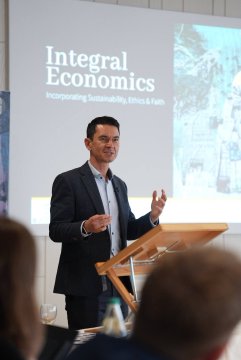
  • Centre for Faith and Society (Glaube und Gesellschaft), University of Fribourg: I help lead and teach a course on Integral Economics, based on Catholic Social Teaching, which has a cohort of international students.
  • Selwyn Foundation: a New Zealand non-profit working on long-term solutions for aging well, where I provide services enabling AI deployments in support of health-related initiatives for Māori and Polynesian communities, with particular attention to issues of data sovereignty and ethics, including shared infrastructure development for iwi Māori and kaupapa Māori healthcare providers.
  • Home Foundation: a New-Zealand housing development non-profit where I helped develop innovative financial structuring for social and affordable housing provision, and now am an external board adviser.
  • The Wilberforce Foundation: a New Zealand philanthropic trust, where I am an external board adviser on strategy and grant funding for AI-related initiatives in Aotearoa/New Zealand, with a particular focus on Māori and Indigenous communities.
  • Tū Whakahē Waipiro: a Māori health organisation, where I undertook work on data sovereignty for AI, and public policy.
  • Christian Savings: the only charitable lender and deposit-taker in New Zealand, where I helped develop liquidity management, regulatory compliance (AML/CFT, capital adequacy, etc.), and financial operations.
  • Te Rarawa: a Māori tribal group where I worked on analysis of a carbon-credit revenue generation scheme for a forest the group own.
  • Te Wānanga Ihorangi: a brand new full-immersion Māori language school in New Zealand, where I helped raise grant funding of several million dollars.

Interest rate trader — Vice President, Barclays Capital, London (2000–2011)

Barclays was the largest participant in the UK government bond (gilt) market. I was the short-dated gilt market-maker from January 2007. Part of my role was gilt swap spread trading for the short end of the curve. My market-making responsibilities involved contact with a range of state and private sector clients and other institutions. This included regular contact with the UK Debt Management Office, a number of central banks and other international government agencies, pension funds, and hedge funds.

I developed expertise in counterparty risk and collateral management for derivatives products. At the time of the Lehman bankruptcy I helped develop a process for large-scale unwinds of derivatives positions, which we deployed effectively. I also took part in graduate recruitment and development. Prior to my gilt trading role, I was a software developer, and a junior interest rate swap trader from September 2004 to December 2006, and also ran a small interest-rate options book. Barclays retained me as a consultant during my PhD in York. After I moved to Oxford in September 2010, Barclays employed me as a consultant over the summer of 2011.

Before moving to the trading desk, I was originally a commodities software developer, developing a web-based front office system to replace paper deal entry (retained as a contractor from Sep 2000 while working on my PhD in Artificial Intelligence, ceased work Sep 2002 to focus solely on the PhD, rehired for rates in 2003). From 2003, I was a rates software developer, working on eT (Barclays Capital’s electronic trading platform for fixed income products).

While I worked in Canary Wharf, we lived in Bethnal Green and served in charitable work there, including in homelessness outreach, youth work, and substance dependency ministry. For two years we lived in a housing association block.

§ 08

Governance

As part of my involvement in the for-purpose sector, I have undertaken a range of not-for-profit governance roles. Some of these, such as Chairperson of Te Whare Ruruhau o Meri and Trustee of the Auckland City Mission, were long-term and substantial commitments, while several others were short-term roles where I was generally involved in order to assist with some aspect of change. I was a member of the New Zealand Institute of Directors, and have spoken and written on governance matters.

Key governance roles

Chair Of The Board Of Trustees, Te Whare Ruruhau o Meri Trust Board (Jun 2018 - Apr 2024)

A Kaupapa Māori social service provider, primarily focused on family harm and sexual violence response and prevention services. I was appointed to the Board directly as Chairperson, and led the organisation to more than double in size (in both turnover and service delivery), and appointed a new CEO. We achieved a modest surplus each year and formed a Foundation to build an asset base and diversify funding sources. We pioneered a multi-agency response to social services delivery, in partnership with the New Zealand Police.

Bloomberg News article on multi-agency partnership approach

Trustee and Audit & Risk Committee member, Auckland City Mission (Jan 2019 – Jul 2023)

The Auckland City Mission is active in relieving poverty and homelessness, with annual revenue of about NZ$40m (peaked at NZ$61m). During my time on the board, we have completed a NZ$120m+ building project in central Auckland (Mission Homeground), which has achieved international recognition, and includes New Zealand’s only specialist medical detox accommodation. Alongside that we significantly increased turnover and service delivery, and Māori cultural awareness.

NZIA award for Homeground Book on Homeground

Trustee, Venn Foundation (Dec 2018 – Sep 2023)

An education charity for Christian vocational formation through residential internships and other programmes focused on supporting people in working life. Chair from 11/2019–11/2022.

Trustee, Te Hui Amorangi ki Te Tai Tokerau Trust Board (Nov 2017 – Sep 2023)

Oversees about $27m of property assets and $2.5m of investment assets, spread through Auckland and Northland. Chair from 08/2018–05/2022. I personally oversaw the investment portfolio, and led in taking the Trust from no employees to 2.5FTE to date.

Finance Subcommittee and Ministry and Education Subcommittee, Komiti Tumuaki (2017 – 2024)

The finance subcommittee oversees the finances of the Māori Anglican bishopric of Te Tai Tokerau. The consolidated entity has turnover of just under $2m/annum. From 2021 I transitioned to leading the other main Subcommittee, which oversees the licensing of ministers.

Short-term governance roles

Chair, Te Kaunihera, Saint John’s Theological College (2020 – 2022)

St. John’s Theological College is the residential seminary for the Anglican Church in Aotearoa, New Zealand and Polynesia. It is also the oldest tertiary training institution in New Zealand (and older than any in Australia).

Member, National Governing Council, Laidlaw College (May 2019 – Nov 2020)

Laidlaw College is one of the largest providers of theological education in Aotearoa, and in particular all the tikanga Māori students at St John’s College receive training at Laidlaw.

Member, Te Tauihu (Dec 2017 – Dec 2019)

Te Tauihu is the governance body for Orongonui, the in-house theological training programme for Te Pihopatanga o Te Tai Tokerau.

Member, New Zealand Anglican Church Pension Board Investment Committee (Apr 2018 – Aug 2019)

The investment committee oversees assets of over $200m, under various constraints around pension and other regulations.

Observer, New Zealand Anglican Church Pension Board (Jul 2018 – Aug 2019)

For much of my time on the Investment Committee, I was also able to be a board observer for the main board.

Director, Affordable Housing Aotearoa Limited (Nov 2017 – Aug 2018)

Founding director of this charitable arm of ACANZP. Resigned in order to undertake housing developments in Te Tai Tokerau without conflicts.

Trustee, Karuwha Trust (Jun 2018 – Sep 2019)

The trust undertakes educational and historical work around the early mission and colonial history of Aotearoa, and bishop Te Kitohi Pikaahu is its patron. I helped to grow and secure a funding base for the Trust and give direction to growth in the range and scale of Karuwha’s activities.

Chair, WEA Council for Business and Theology (Nov 2015 – Dec 2017)

I was a founder and chair of this group, which promoted the theology of business and built a network around the world.

Chair, Glen Taylor School Board of Trustees (Feb 2015 – Jun 2016)

Decile 1 primary school. I initially joined the school’s Board of Trustees in late 2014 in an advisory capacity and from February 2015 as chair. My role involved rebuilding a dysfunctional board, in conjunction with a special adviser appointed as part of a Ministry of Education statutory intervention. In 2015 we recruited a new principal and deputy principal, substantially restructured the staff, saw the roll grow by 15% and student achievement (particularly for Māori) increase, put in place a property plan and agreement with the MoE, and completed a new charter and strategic plan. In mid-2016 we received a positive Education Review Office report and exited the MoE’s statutory intervention. The school now has a larger board with excellent Māori and Pasifika representation. I stood down in order to move to Oxford.

Treasurer, The Good Shepherd Mission (2006 – 2007)

This church, based in Bethnal Green, operated as a mission within an extremely poor area of east London. The majority of the population in the area around the church was composed of immigrants.